"When logic and proportion have fallen sloppy dead"

"When logic and proportion have fallen sloppy dead"
click pic to reminisce

final jeopardy challenge, September 2011  

Posted by howard in nyc

Monday 9/26
Category: FAMILIAR PHRASE ORIGINS
Clue: In medieval times, an act of bravery got you dubbed a knight & won you a pair of golden these

Answer:  What are spurs?


Tuesday 9/27
Category: ENGLISH WRITERS
Clue: English poet Thomas Hoccleve, a contemporary of this man, called him the "firste fyndere of our fair langage"

Answer:  Who was Geoffery Chaucer?


Wednesday 9/28
Category: THE CHANGING U.S.A.
Clue:  According to the census, this point has progressed westward since the U.S. was founded, & has moved southwest since the 1960s

Answer:  What is the center of population distribution ?


Thursday 9/29
Category: THE 20th CENTURY
Clue:  In February 1967 this Asian leader said his people would "never agree to negotiate under the threat of bombing"

Answer:  Who was Nguyễn Sinh Cung, aka Ho Chi Mihn ?


Friday 9/30
Category: 
Clue:

Answer:  Wh ?


Monday 9/19
Category:  AMERICAN WRITERS
Clue:  In the 1840s he wrote, "I ask for, not at once no government, but at once a better government"

Answer:  Who was Henry David Thoreau?

(yeah, i say the same thing, and everyone thinks i'm nuts.)


Tuesday 9/20
Category: NAME'S THE SAME
Clue:  Name shared by a popular world sport & a member of the Gryllidae family

Answer:  What is cricket?


Wednesday 9/21
Category: OSCAR WINNERS
Clue:  The most recent father & daughter to win acting Oscars; he won for playing a veteran, she for playing a mental patient

Answer:  Who are Jon Voight and Angelina Jolie?


Thursday 9/22
Category: PHILOSOPHY
Clue:  Nietzsche wrote, "once you said 'God' when you gazed upon distant seas; but now i have taught you to say" this word.

Answer:  What is "ubermensch" or 'superman'?  just last night, listening to the ny philharmonic play Wagner (Overture to Tannhauser), i was thinking how the music made me feel like an ubermensch.


Friday 9/23
Category: AMERICAN BUSINESS
Clue:  In the 1880s he developed 'Crystal A Caramels'; a product under his own name came out in 1900

Answer:  Who was Milton S. Hershey?
if it involves chocolate, i would not bet against me.

it's not your job to be as confused as Nigel  

Posted by howard in nyc in , ,

9/9/2011  17:55

yet, our leaders seem to be quite confused this week.

the deficit and the debt ceiling were the recent crisis to be solved.  but now, spending $400 billion is imperative to create jobs.  we must cut spending, so important is this need, a congressional supercommittee has been created.  but we must increase spending, right away.

that was president obama, speaking to congress.  he is not alone.  the ben bernanck was confused.

even though he specified severe unemployment, fallen housing prices, high gasoline and food prices and high household debt as current problems.  yet he was puzzled as to why consumer spending is so weak.

now i have yet another reason for unease.  i have been uneasy, dysphoric, and downright depressed because i see the economic calamity unfolding as, well, calamitous.  but nearly everyone around me in america sees things quite differently.

i figured the folks nominally in charge told a bunch of lies (for our benefit, of course) while understanding the score.  the true state of the economy.

now, i am not so sure.  particularly the ben bernanck.  i have vacillated between thinking him evil, knowing exactly what he is doing serving the banks and speculators, and thinking him incompetent, frantically pulling levers and spreading liquidity, not understanding why his drastic monetary stimulus has failed to promote sustained economic growth and prosperity.

the way he sounded yesterday, now i'm pretty sure it is the latter.  he did everything his lifetime of academic work promised would prevent economic depression and deflationary collapse.  he printed up a buttload of money.  he did everything possible to recapitalize insolvent banks.  he manipulated interest rates and the cost of credit to near zero.  he weakened the dollar as far as he dare.  and all he got was energy and food inflation, severe enough to negatively drag on the economy.  no decrease in unemployment, no increase in exports, no GDP growth once QE2 ended.

no wonder he looks and sounds like a broken man.  and no wonder he has nothing new to offer, despite plenty of opportunities (stock market volatility, big jackson hole meeting).  i am figuring we will get little more than words out of the ben bernanck and the fed over the next year.  because the cost of aggressive monetary policy (printing money and buying treasury securities or other 'assets') has become too great--inflation of oil and food prices, weakening of the dollar toward the breaking point.

even if things get so desperate that he tries QE3, those costs will reassert themselves even more quickly than in previous turns.

as for the other folks who are supposed to be less confused, the president and the leaders of the congress bounce wildly from spending to cutting, in their rhetoric.  the third rail of politics is no longer social security, but it is now raising taxes.  woe to anyone standing for election who dares mention increasing taxes, on rich or middle class.

the superficial nihilism of the gop is fake; no one loves big government more than a republican holding office.  they talk 'starve the beast in the cradle' then when they hold power, they nurture the beast on borrowed money, pushing the due date off to the future.  and the superficial populism of the democrats is equally fake; their true loyalty is to the big campaign contributors and to the status quo.  they push off into the future the recognition on the part of their base that they have been bought off temporarily by 99 weeks of unemployment bennies on the wall and 1 in 7 americans being fed with food stamps is a holding action, not true populism.

but mr. obama, railed all summer about the need to cut spending.  even social security spending.  now, he insists $400 billion in new spending is just the ticket.  and he'll explain in 11 days how he will pay for it.

yeah, sure.  one truism, proven over and over again.  the spending always happens.  the paying for it in the future, never happens.  that is how the deficit doubled since the last presidential election (didn't he promise to cut the deficit in half?)  that is how the unfunded liabilities of the government swelled to $100 trillion with a T.  that is how the literal debt, measured by the treasury bond market, grew to $14 trillion so quickly.

an economy built upon credit, once it begins to fall apart because of too much accumulated debt, cannot be repaired with more debt.  an economy built upon consumer spending and consumption, once it tops out because of too much consumer debt, cannot resume growing with more consumer borrowing.

why is that so confusing?

i nearly forgot.  greece is gonna blow up within a matter of days/weeks.  this could spread slow or quick.  but spread it will.  karl thinks "It's Over" and he may be right. 

and here are three good 9/11 anniversary articles.  the first sums up my thoughts precisely.

Debt Ceiling Breached! ! !  

Posted by howard in nyc

Horrors!  Default! End of our way of life!  isn't that what geithner and obama said would happen?

what a bunch of fucking liars. (h/t zerohedge.com)

see the numbers for yourself:  


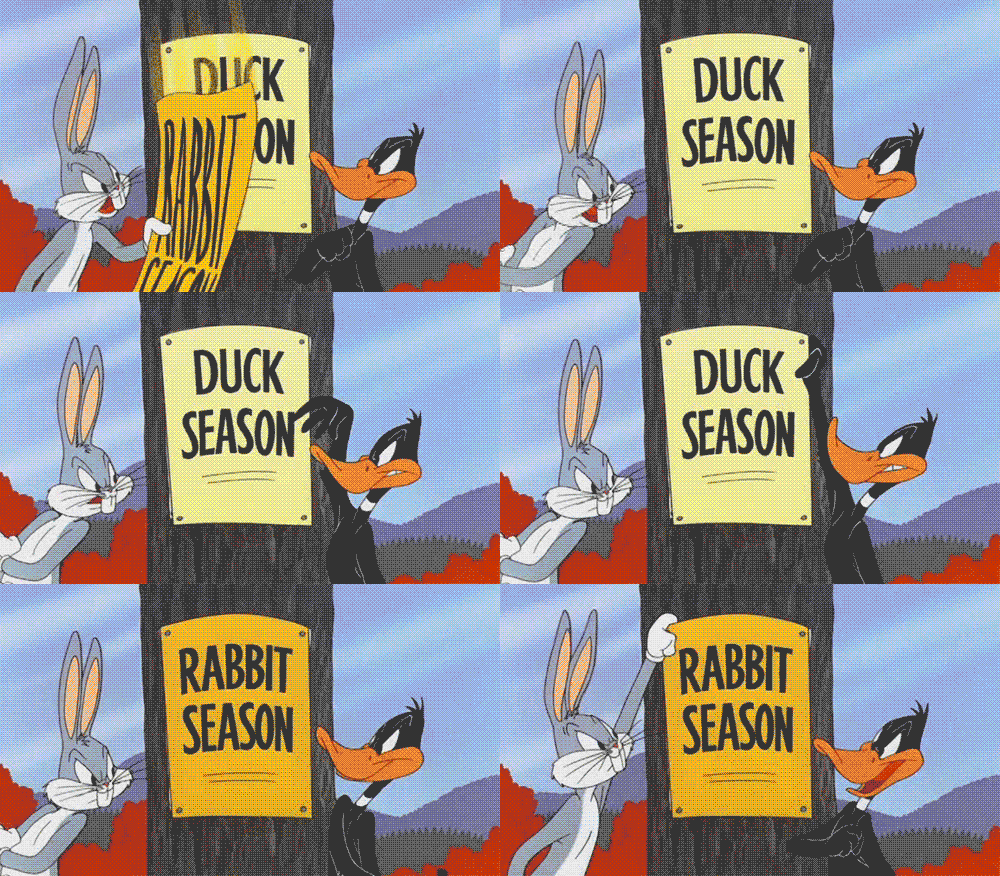
inflation; deflation; duck season! rabbit season!  

Posted by howard in nyc in , ,

9/3/11  17:50

some of my best lessons have come from people with whom i seriously disagree.  i am often rewarded when i read/pay attention to viewpoints and ideas provided by smart, thoughtful people i think are wrong about one thing or another, large or small.


Jesse, on his wonderful daily blog, Jesse's Café Américain is one of those.  kinda sorta.  there is precious little of his economic and market analysis and opinion with which i disagree.  but, he is an 'inflationist' (horrors!).  no, he does not believe inflation is a good thing; he anticipates the resolution of our economic collapse will be inflation.  he proffers that the commodity inflation we have experienced was an entirely expected result of conditions and behaviors by leaders over the past few years.  he called it before and during QE1 and QE2.  mad props for his profferings.

he writes a wonderful piece today, entitled About Those Falling Interest Rates and the Fallacy of Monetary Deflation at the Zero Bound

folks spend time arguing inflation vs deflation without ever clarifying their definitions of or understanding of the terms.  jargon, technicalities, and lack of agreement over simple historic events confound defining and mutual understanding of the very definition of these words.  even once those chores are complete, inflation and deflation are difficult factors to understand, much less to forecast.

money is an even more difficult, complicated concept.  juxtaposed by the apparent simplicity of the question 'what is money'?

Jesse begins with addressing what is and what is not money, in the context of the events of the last few years.  i appreciated that he and others do not consider credit and debt to be money (many other folks, including me, do so consider).  but i did not understand why he did not consider credit to be money.  until i read his piece today.

Let me give you three things to think about.

First, credit is NOT money. Money can be created from a number of sources throughout an economy. The expansion of credit at the business and banking level, often involving savings and fractional reserve leverage, is the major organic source of money, the point of its creation from economic activity or transactions themselves.   It is the most utilitarian form of money, because it is directly tied to what one might ordinarily expect to be productive investment and economic benefits.

Sometimes this mechanism is distorted and abused, in the case of fraud or reckless lending for speculation as an example, and then the money supply begins to decouple from the real economy.  It is the job of the regulators and the Fed to control this.

Like gold or any other asset or liability, credit must be transformed into a utilitarian form of wealth, or money, in order to effect the exchange. You may HAVE a million dollars in credit somewhere, but at some point someone must agree to transform that credit into actual money for you to use it. If an unused million dollar credit line expires, we do not see ourselves as a million dollars poorer.

When organic credit expansion fails to create money, the Fed or the Treasury can step in and create money non-organically, that is, not as the result of economic activity. In the case of an external standard, the Treasury can formally devalue the currency, as the US had done in the first half of the 1930s. Monetary authorities do not like to do this, because it makes their activity more transparent, and therefore more controversial. 

i don't agree with many of Jesse's points and arguments.  i am not smart enough or knowledgeable enough to counter many of those disagreements clearly or intelligently.  but the essay helps me understand his position and perspective much more than i had previously.  

i will briefly state that i believe his distinction between credit and conversion of same into actual money is a distinction without a difference, when applied to the US economy of the past 15 years.

without bothering to try to find some actual numbers (hey, i'm a blogger, not a frigging economic historian; and i ain't getting paid for this), i am gonna take a wild leap and guess that the vast majority of credit made available during the 90s and 2000s was actually converted into money (and debt).  and further converted into assets.  housing, other real estate, stocks, bonds, wages, goods and services.  and vast amounts of those debts were destroyed, (default), as were many of those assets (housing/real estate equity and valuations, stock share values).

and, in short, at least i now understand why and how Jesse does not consider credit to be money or a money equivalent.  i don't agree, but i get where he is coming from.  and i sure as shit understand he may well be right, and i may be wrong.  (um, i think the betting public would be justified and correct in setting odds on him, and against me.)

unfortunately, Jesse falls into some rhetorical traps (while discussing the mother of all liquidity traps), lumping all of the opposing point of view into a mis-characterization he describes.  and some name calling.  these are tense times; there is a lot of falling into such traps going around.

Jesse correctly (imo) states a pair of truths in his other two of three things to think about:

The second thing to remember is that the extent of inflation or deflation is a policy decision in an otherwise unconstrained environment.

Greece does not have such a choice, for example, because the ECB controls their currency.  The US probably has the most choice of all, because it not only owns its currency, but the dollar is also still the world's reserve currency. While the audience is not captive, it is at a disadvantage.

The third thing is that the creation of money from the Fed or Treasury may result in more money, but it may not result in a sustainable recovery.    Money created by the Fed is high powered money, created as it were from the will of the monetary authority's policy.

Money creation, or monetary stimulus, works well in situations wherein the economy has fallen into a temporary slump, especially because of some exogenous shock or a slack period that is cyclical in nature, such as seasonal variation.

But in the event of a secular crisis or problem, monetary stimulation is a palliative, but no cure.   The remedy lies generally on the fiscal and political policy actions, with the aim of correcting or repairing whatever had caused the problem in the first place.  

Monetary stimulus alone, without the will to effect political reform for example, results in very uncommon economic conditions, one of which Keynes described as a 'liquidity trap.'

even if i reject my own analysis, opinions, and judgments that rest upon what i have managed to learn about our economic collapse, and 100% agree with Jesse's formulation of the finance/macroeconomic world, i can continue to hold tightly to one of my central ideas regarding the path of our collapse.

it is an idea that was little more than a wild-assed guess in 2007.  and today, while i have acquired a rudimentary understanding of macro and finance, this idea is informed much more by human action, than by numbers and exponents.  (wtf did you expect?  i love mises to pieces; and Human Action is a great fucking book.)

as bad as a deflationary depression is for the interests of the true powers that be, the people who actually run the country and the economy (not our puppet president and elected officials), a hyperinflationary collapse is worse.  much worse, if you are a superwealthy former chief executive of a wall street bank, pharmaceutical house, or other mega corporation.

and while collapse is inevitable, particularly since zero significant reform and restructuring has occurred in our banking and finance system, the mode of collapse is ultimately a policy choice.  (Jesse said so!)  and while high inflation is very appealing if you are a short-sighted politician (sorry for that redundancy), it is the only thing more scary to the uber-rich who actually call the shots than deflation.

i learned a lot from this essay, gained tremendous food for thought, and came to value his ideas and opinions that are directly contrary to my own even higher than the price of Apple stock three weeks ago.  like Chomsky, Richard Brookheiser, Gore Vidal, at times Howard Zinn, and tons of others, thank goodness for really smart people whose ideology i do not share, but whose ideas i always value and often find agreement.

i'm tired  

Posted by howard in nyc in , ,

i know how you feel, lily.  sing it girl.
8/6/11 15:27

one thing that fatigues me is continuing to spoonfeed my friends, in real life and on the internets, the facts and obvious conclusions that stem from those facts about the sorry state we find ourselves.  the economy, the political system now 100% captured by the big money interests, the society that embraces lying, cheating and stealing as a way to get ahead, while remain oblivious or in active denial about what is in front of our eyes.  denial most often activated by sinking into emotionally satisfying lies, that one party or another is to blame, that things will get better because they always do, that what we are living through is not unique to our lifetimes (unless you lived through the 1920s and early 1930s).

particularly tiresome is folks who will argue with me over facts.  often after admitting they are not knowledgeable or informed about a particular item or subject, about which i have spent a lot of time and effort to learn.  then they proceed to argue that i am wrong, because they 'feel' it must be wrong.  or they can't 'accept' that what i say is possible, much less is true.

so stop doing it, asshole.

thanks.  i needed that. hey, those voices in my head have steered me pretty damn straight lately. i'd be a fool to stop listening to them now.

and it is not as if i am infallible.  i am often wrong.  like yesterday, about the s+p downgrade of the creditworthiness of the united states of america.  i don't mind being wrong, when i am i promptly admit it and when needed, to make amends.  but facts prove me wrong, not what people feel, or what they can or cannot accept.

i did not think the s+p would downgrade.  wrong, bubba.  fine.  i'm interested in why.  why i was wrong, but much more importantly, why they downgraded.

(hint--it was not because all of a sudden this week the creditworthiness of the nation took a dive.  if these assholes were honestly and systematically evaluating fed credit, this downgrade would have come years ago.  if not decades ago.)

(hint #2--it was not because these assholes are honest, objective evaluators of anything.  their record makes this obvious.  how did they rate AIG?  AAA.  how did they rate all those junk mortgage backed securities?  AAA.)

i don't know, but i have a good idea why.  what led me to my reasoning, the following articles.  read 'em yourself, fish for a lifetime.


Is Too Much Significance Given to U.S. Credit Rating?


Police raid Milan offices of Moody's and Standard & Poor's


that first article is long; skim it and you get the jist.  there was another good piece on S&P's abysmal record of collecting fat fees for marking shit AAA, from michael shedlock's blog, but i cannot find it now.  him, and yves smith, are my first reads darn near every morning.  the ponds where i do my fishing.


but i'm also tired of repeating where i get my news and analysis.  i guess i'll start a blogroll on the right side, like all the cool kids.

last thing that makes me tired.  my personal dissonance.  seeing the facts, rejecting the overwhelming sea of lies, thinking instead of emoting, that is hard enough.  but recognizing the realities of our economic and political failures, while almost everyone else is unaware, or blissfully wallowing in the lies, delusions and emotional salves provided by the folks running the show for their own benefit, this disconnection from the mainstream weighs me down.  makes me tired.  really really damn tired.

at least that is coming to an end.  folks are starting to wake the fuck up; lights are flickering on, dots are being connected.  it is about damn time.


hide yo kids, hide yo wife!  

Posted by howard in nyc in , ,

7/11/2011  14:23

I have not ranted and spewed venom, errr, I mean I have not crafted a thoughtful and restrained essay on economic and financial collapse in a few weeks now.  I have not been moved to words by any recent non-events.  All due respect to Casey Anthony and the federal budget farce coupled to the juvenile lie of 'pending default', the two leading non-events being tracked faithfully by the joke of our news media and the sugar high distraction of the cultural consciousness.  I don't know which is more surprising:  the number of friends and acquaintances who were outraged over some white lady's acquittal, which i would've expected them to be unaware of, much less so strongly opined about; or how many of the same folks believe that TBTB are in any danger of failing to make a $30 billion monthly interest payment, out of $300 billion monthly expenses, when monthly income is ~$175 billion.

The interest on the national debt will be paid before salaries of all those government employees who do not carry weapons, or the social security/medicare/food stamps payments to the hoi polloi (yes, that includes doctors, or 'health care providers', which I am told is the preferred term.

Every fucking news report has the word 'default' in the lead.  And it is a big fat hanging lie.

See?  I have nothing much new on my mind about real events in the world.  Wars, rumours of war, unemployment, bank fraud, sovereign debt crises (at least that is heating up--finally).  Just waiting for another big shoe to drop, in Damascus, Tripoli, Brussels or Wall Street.

In the meantime, two things I read that I really liked, and wanted to share.

First, from Jesse's Café Américain, one of my daily reads.  A wonderful descriptive analysis (or maybe analytic description) of our horrible, hated president:


A bright fellow no doubt, but unseasoned by things like family, tradition, and the personal experience of hardship: a great story teller, a rationalizer, a perpetual outsider, and a thoroughly modern relativist. You have to keep your eye on what he does, rather than what he says. But that is a given with all modern managers.


The other, from a source I do not regularly read, but via Yves at Naked Capitalism, her daily news and commentary links are a daily don't miss for me.  A blog called Decline of the Empire, a clip from a post non-sarcastically (and non-ironically) called This Time Really Is Different:

I've got some news for people like John Mauldin, Barry Ritholtz, Carmen Reinhart and Ken Rogoff—this time is different, but not in the sense you intend. To understand what is happening in the United States, it is necessary to go far beyond an historical survey of financial crises. You must consider the specific historical circumstances that led to the current crisis. Such a review would include but not be limited to the following observations—
  • The United States has been hemorrhaging manufacturing jobs for 30 years.
  • Almost all of the income gains made during that time went to the top 10% of wage-earners, with most of them going to the top 1%. Wealth inequality grew accordingly.
  • Health care costs have been soaring all that time.
  • College tuition costs skyrocketed at a pace far beyond the rate of inflation.
  • Households took on more and more debt to replace lost income.
  • We had not one, but two, substantial economic bubbles during the last 15 years. Without those bubbles, how much would the U.S. economy have grown?
  • The private debt to GDP ratio grew and grew, clearly indicating that more and more debt was required to add an additional point of GDP.
  • The Federal Government more and more became the tool of monied special interests.
And so forth. When people endorse Reinhart and Rogoff, we are supposed to understand that the Tough Times we're experiencing now have a well-defined beginning—the financial crisis after the fall of Lehman—and will have a well-defined end—however many years it takes to work through the credit problems. This is utter nonsense. The "historical obversations" I listed above are in fact the root causes of our current predicament.

And in each case, the historical trend has not changed, or has gotten worse. Households now have only slightly less debt than they did before the crisis, but trillions of dollars of housing wealth has disappeared. Health care costs continue to soar, as do college tuitions. Income gains still go to the wealthiest Americans. In short, nothing has changed.

That leaves those who want to believe that All Will Be Well with the same unsolvable dilemma we started out with: how do you tell a credible story that everything will turn out OK? I'm sorry, but no amount of convenient, hopeful rationalization is going to change the American disaster while the roots of the crisis remain in place. The financial meltdown was the proximate, not the ultimate, cause of America's economic woes.

This time really is different.

July Jeopardy  

Posted by howard in nyc

Monday 7/25
Category:  BOOKS ABOUT BOOKS
Clue:  The 2003 bestseller "The Meaning of Everything" is subtitled "The Story of" this reference classic

Answer:  What is the Oxford English Dictionary?


Tuesday 7/26
Category:  THE NEW TESTAMENT
Clue:  This miracle that happens in all 4 Gospels, including Mark 6 & Luke 9, has elements that symbolically represent Jesus

Answer:  What is the feeding of the multitudes, with the loaves and fishes?


Wednesday 7/27
Category:  ROYALTY
Clue:On the run following the siege of Oxford, he surrendered May 5, 1646 near Newark on Trent (*not Newark on Passaic)

Answer:  Who was Charles I?


Thursday 7/28
Category:  WORLD HISTORY
Clue:  Surus was the last known one of these to survive a mountain crossing in the 3rd century B.C.

Answer:  What is an elephant ?  (hannibal, alps, dead punics, you know)


Friday 7/29
Category:  LOS ANGELES LANDMARKS
Clue:  A James Dean memorial can be found adjacent to this structure, located at one of the high spots in Los Angeles

Answer:  Where is the Hollywood sign? 


Friday 7/22
Category: FAMOUS AMERICANS
Clue: In 1909 he sent the message "Stars and Stripes nailed to the Pole"

Answer:  Who was Rear Admiral Robert Edwin Peary? 


Thursday 7/21
Category: 20th CENTURY LEADERS
Clue: Time Magazine first mentioned him in 1939, when his father sent him on a diplomatic errand from London to Glasgow

Answer:  Who was John Fitzgerald Kennedy?


Wednesday 7/20
Category: SPORTS MOVIES
Clue: Their team colors were yellow and white & they were originally sponsored by Chico's Bail Bonds

Answer:  Who are the Bad News Bears?  Let Freedom Ring!


Tuesday 7/19 Category: 19th CENTURY NOVELS
Clue: This novel's first epilogue says, "the activity of Alexander or of Napoleon cannot be called useful or harmful"

Answer:  What is Tolstoy's War and Peace?


Monday 7/18
Category:  WORLD GEOGRAPHY
Clue: Of the 4 largest Asian countries in area, it's the only one that borders the other 3

Answer:  Where is China?  (Russia, India and Kazakhstan are the other three)


Friday 7/15
Category:  TRADEMARKS
Clue:  In 1987 a maker of fiberglass insulation became the first company to trademark a color--this color

Answer:   What is pink?

let steven answer that question:


Thursday 7/14
Category: PRESIDENTIAL LIBRARIES
Clue:  Opened in 1971, his presidential library is the farthest south

Answer:   Who was Lyndon Baines Johnson?


Wednesday 7/13
Category:  NAME THE POET
Clue:  "The spirit who bideth by himself / in the land of mist and snow / he loved the bird that loved the man / who shot him with his bow" 

Answer:   Who was Samuel Taylor Coleridge?  get your albatross!

Tuesday 7/12
Category:  COMIC BOOK HISTORY
Clue:  On the cover of the 1941 first issue of this comic book, the title hero punches Hitler in the jaw

Answer:  Who is Captain American?


Monday 7/11
Category:  18th CENTURY QUOTATIONS
Clue:  2 yrs. before his 1794 execution, he said, "I am no courtier, nor moderator…nor defender of the people:  I am myself the people"

Answer:  Who was Maximilien François Marie Isidore de Robespierre?


Friday 7/1
Category:  BRITISH AUTHORS
Clue:  She described her work as "human nature in the midland counties" & involving "three of four families in a country village"

Answer:  Who is Jane Austen?